

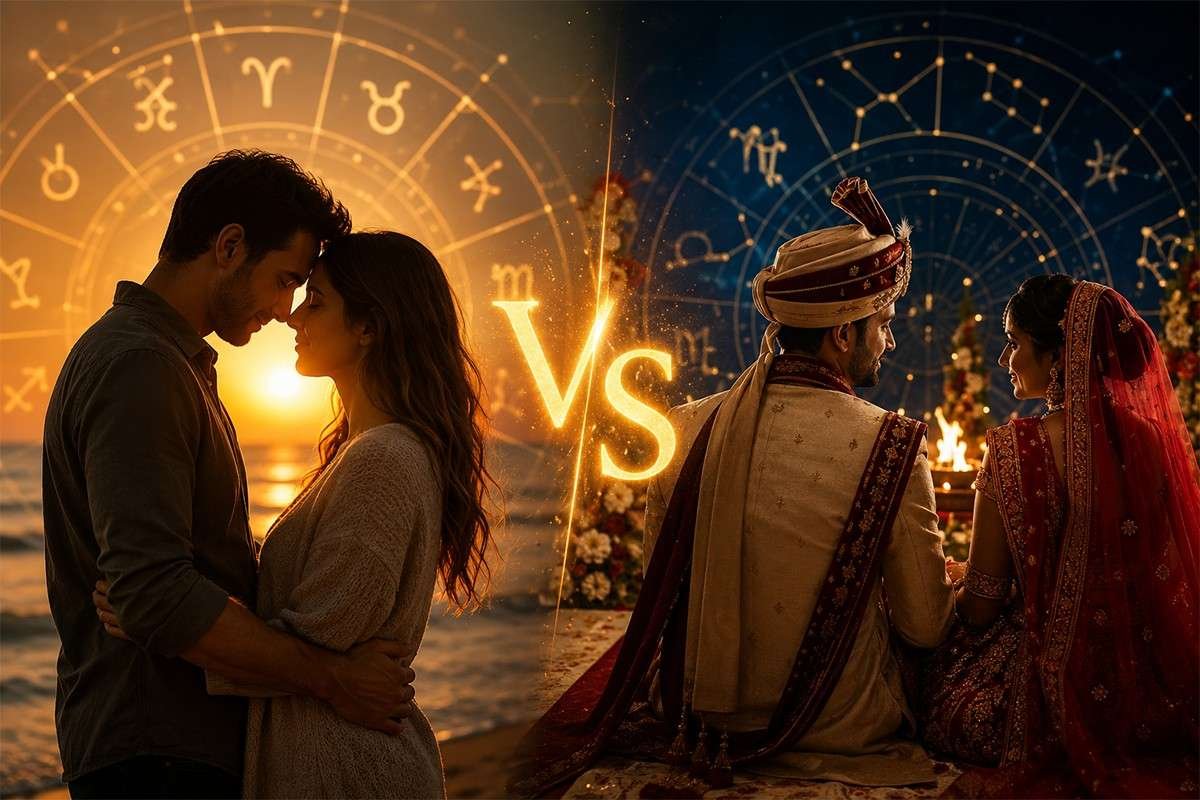
The debate over love marriage vs arranged marriage has existed in Indian society for generations, and astrology has traditionally offered guidance for both paths. Many people assume astrology only applies to arranged matches, since horoscope matching is such a familiar step before an arranged wedding. In reality, astrologers evaluate love matches too, just through a slightly different process. This article explains how compatibility is assessed in each context, and why neither path is astrologically “safer” than the other.
How Astrology Approaches Arranged Marriages
In an arranged marriage, families typically approach an astrologer before the couple has spent much time together. Because there is limited personal history to draw from, the astrologer relies heavily on a structured comparison process called Guna Milan, or Ashtakoot Milan. This system compares eight specific factors between two birth charts, including temperament, mental compatibility, and health indicators, and assigns points out of a total of 36.
Guna Milan is useful precisely because it does not depend on the couple already knowing each other well. It gives families an early, structured sense of whether two charts are broadly compatible before deeper emotional investment begins. For a closer look at how this works in practice, our horoscope matching service walks through the full process.
How Astrology Approaches Love Marriages
When a couple has chosen each other already, the astrological approach shifts. Instead of using Guna Milan as the primary tool, astrologers typically perform a direct chart comparison, examining both individuals’ Moon signs, Venus placements, 7th house conditions, and relevant dashas together. This is sometimes called Kundli Milan in a broader sense, but the emphasis moves from “should these two people be introduced” to “how can this specific relationship be strengthened.”
This distinction matters. A couple in a love relationship is not asking whether to begin something new; they are usually asking how to navigate family approval, timing of marriage, or specific friction points that have already appeared. Our work with clients seeking a love marriage specialist consultation typically focuses on exactly these practical questions.
Key Differences Between the Two Approaches
While both paths use the same underlying astrological principles, the emphasis and sequence differ in a few important ways. Understanding these differences helps set realistic expectations for what a consultation can offer:
- Arranged marriage astrology usually happens before emotional attachment forms, so it focuses on screening broad compatibility.
- Love marriage astrology usually happens after attachment has already formed, so it focuses on strengthening and troubleshooting an existing bond.
- Guna Milan produces a numerical score, while love marriage chart comparison is more qualitative and focused on specific houses and planets.
- Family and social approval often feature more prominently in arranged marriage consultations, while personal timing and family persuasion feature more in love marriage consultations.
- Remedies in arranged marriage cases often address compatibility gaps, while remedies in love marriage cases often address obstacles like family resistance or delays.
Is One Path Astrologically “Safer” Than the Other?
This is one of the most common misconceptions clients bring to a consultation. Neither love marriage nor arranged marriage is inherently more astrologically secure. A high Guna Milan score does not guarantee a conflict-free arranged marriage, and a lower score does not doom it either — it simply flags areas that may need extra attention. Similarly, a love marriage between two well-matched charts can still face real challenges, particularly around family acceptance, intercaste dynamics, or timing.
What actually matters more than the marriage type is how the specific charts interact, how self-aware both partners are, and how willing they are to work through friction when it appears. Astrology can illuminate these patterns either way, but it cannot replace the ongoing effort a marriage requires from both people.
When Family Approval Becomes the Real Obstacle
For many couples pursuing a love marriage, the astrological chart itself is rarely the biggest hurdle — family acceptance is. This is especially true in intercaste or interfaith relationships, where social pressure can outweigh compatibility concerns entirely. In these situations, astrology is often used less for compatibility scoring and more for identifying favorable timing to approach families, along with remedies believed to ease resistance and encourage open-mindedness.
Clients navigating this exact challenge often find our guidance on intercaste marriage situations helpful, since the astrological and practical considerations frequently overlap. According to the broader tradition described on arranged marriage as a social institution, family involvement has always played a significant role in Indian marriage decisions, which is exactly why astrology developed tools to work with families, not just couples.
How Modern Couples Are Blending Both Traditions
In practice, the line between love marriage and arranged marriage has become considerably blurrier over the past decade, especially in cities and among younger professionals. It is increasingly common for families to first meet through traditional introductions, only for the couple to then spend months or years getting to know each other before the wedding — effectively an arranged introduction that develops into a genuine love match. In these hybrid cases, astrologers often use elements of both approaches: an initial Guna Milan to reassure the families, followed by a deeper chart comparison once the relationship has developed further.
This blended approach tends to work well precisely because it respects both the emotional reality of the couple and the social expectations of extended family. A young professional who met their partner through a matrimonial platform, for instance, is essentially starting from an arranged-marriage structure but making a love-marriage-style decision, and a thoughtful astrological consultation can support both dimensions rather than forcing the couple to pick one framework.
Questions Couples Often Bring to This Kind of Consultation
Regardless of how a couple came together, certain questions come up again and again in consultations: whether the timing is right for marriage, how to interpret a mismatch on a specific compatibility factor, and what remedies might ease friction that has already surfaced. Rather than treating every question as a yes-or-no verdict, a thorough consultation walks through what each factor actually means in practical, everyday terms — for example, explaining that a lower score on one specific Koota reflects a difference in temperament that good communication can offset, rather than a fixed obstacle.
Why Clients Choose Bengali Jyotish Center
Astrologer Raj Bengali has guided both types of clients for years — families comparing charts before an introduction, and couples already committed to each other and seeking a way forward. This dual experience means consultations are tailored to where a couple actually stands, rather than forcing every case through the same process.
Clients also value the honest tone of these consultations. Rather than promising a guaranteed “yes” or “no” on a match, sessions focus on realistic strengths, genuine risk areas, and remedies suited to the actual situation, whether that is convincing a hesitant family or strengthening an already strong bond.
Whether you are comparing charts before an arranged introduction or seeking guidance for a love marriage you have already chosen, personalized astrological insight can help you move forward with more clarity. Contact Bengali Jyotish Center, Main Bazar, Kot Khalsa, Amritsar, Punjab, at +91-9779264257 (call or WhatsApp) or email Bengalijyotishcenter@gmail.com to book a consultation. You can also visit our contact page for more details.
Frequently Asked Questions
Is love marriage or arranged marriage more astrologically favorable?
Neither is inherently more favorable. What matters more is the specific compatibility between the two individual charts, not which path brought the couple together.
What is Guna Milan and is it used for love marriages too?
Guna Milan is a traditional 36-point compatibility system most commonly used in arranged marriages. For love marriages, astrologers usually rely on direct chart comparison instead, though elements of Guna Milan can still be referenced.
Can astrology help convince my family to accept my love marriage?
Astrology cannot force acceptance, but it can offer guidance on favorable timing for conversations and remedies traditionally believed to ease family resistance. Patience and honest communication remain essential alongside this.
What if our Guna Milan score is low but we still want to marry?
A low score highlights areas needing attention rather than ruling out the marriage entirely. A detailed chart reading can clarify which specific factors are weak and what remedies may help.
How do I book a consultation for marriage compatibility?
Call or WhatsApp +91-9779264257, email Bengalijyotishcenter@gmail.com, or visit Bengali Jyotish Center at Main Bazar, Kot Khalsa, Amritsar, Punjab.