

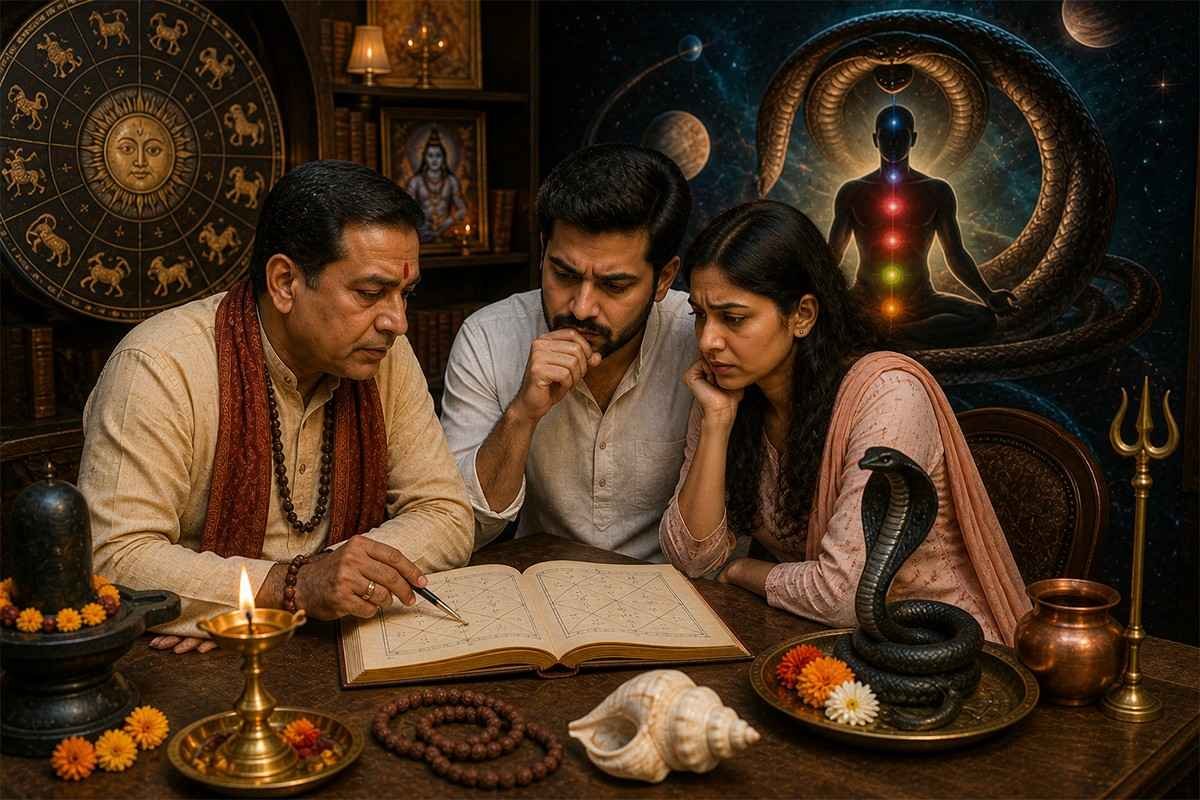
Kaal Sarp Dosha is one of the most talked-about — and most misunderstood — conditions in Vedic astrology. Search the term online and you’ll find alarming claims about ruined careers, delayed marriages, and endless obstacles. At Bengali Jyotish Center, Astrologer Raj Bengali takes a different, more grounded approach: explaining what this dosha traditionally represents, what it doesn’t guarantee, and what genuinely helpful, traditional remedies look like when they’re actually needed.
What Is Kaal Sarp Dosha?
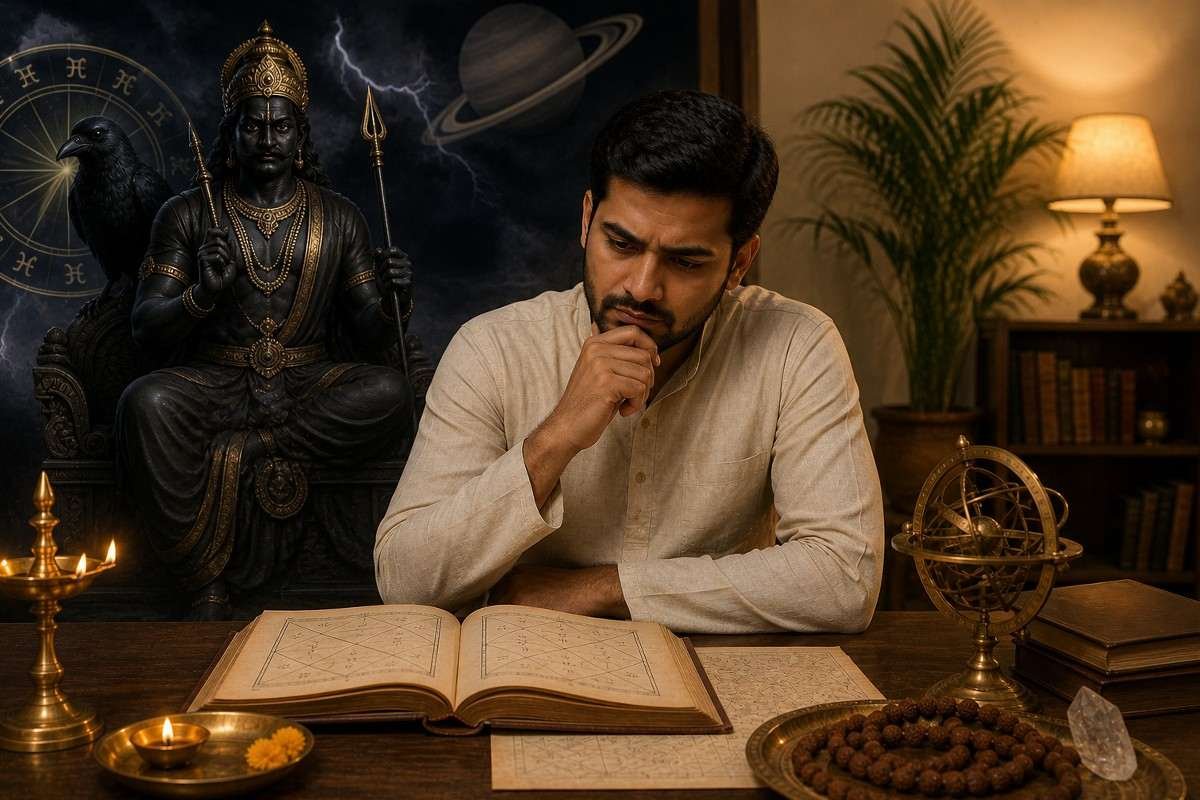
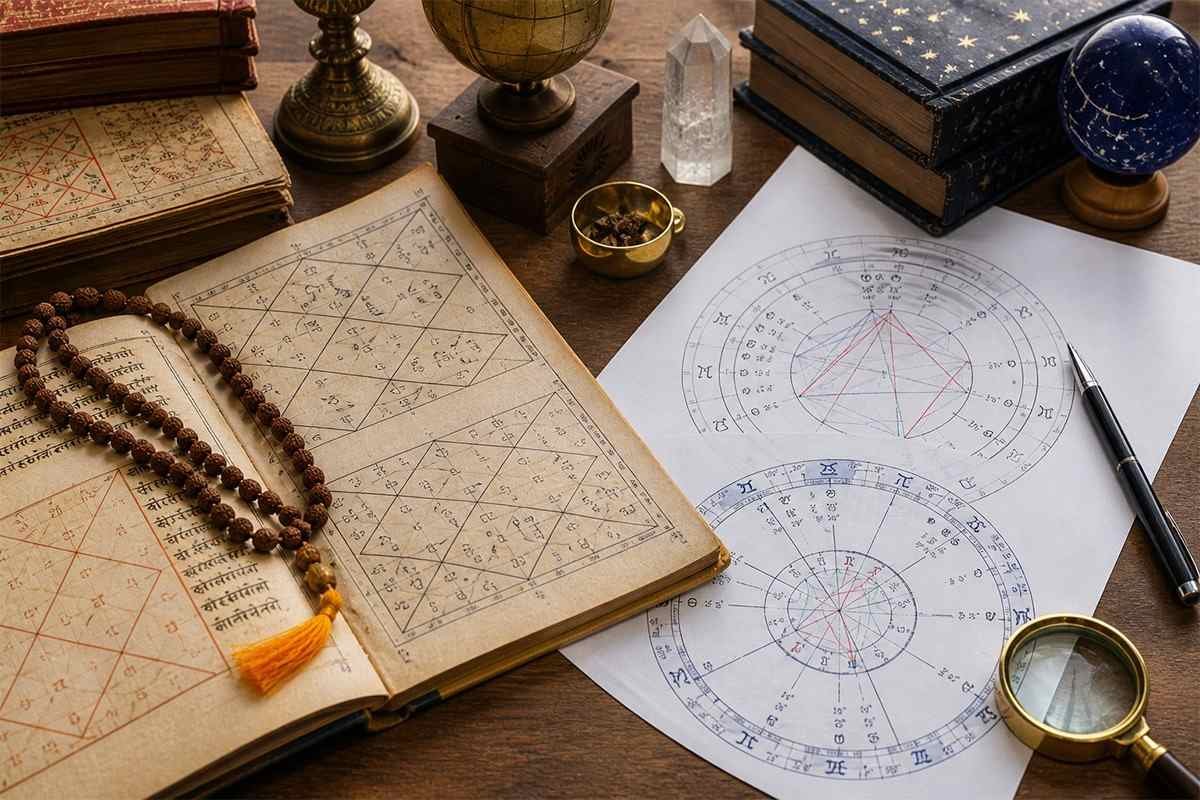
“Kaal Sarp” translates roughly to “serpent of time,” and the dosha refers to a specific chart configuration in which all seven classical planets (Sun, Moon, Mars, Mercury, Jupiter, Venus, and Saturn) are hemmed between the two lunar nodes, Rahu and Ketu, on one side of the chart — with no planet positioned outside that arc. Rahu is traditionally imagined as the serpent’s head and Ketu as its tail.
Rahu and Ketu are not physical planets but mathematically calculated points — the north and south nodes of the Moon — that hold significant weight in Vedic astrology as karmic indicators. You can read more about the broader astrological role of these points on Wikipedia’s article on Rahu. When every other planet is boxed in between these two nodal points, classical astrology describes this as creating a distinctive kind of karmic pressure or tension in the chart.
The Twelve Types of Kaal Sarp Dosha
Depending on which house Rahu occupies at birth, classical texts describe twelve distinct varieties of Kaal Sarp Dosha, each said to influence a different area of life:
- Anant Kaal Sarp: Rahu in the 1st house — traditionally linked to health and self-confidence themes.
- Kulik Kaal Sarp: Rahu in the 2nd house — associated with finances and family matters.
- Vasuki Kaal Sarp: Rahu in the 3rd house — linked to siblings and courage.
- Shankhpal Kaal Sarp: Rahu in the 4th house — associated with home, mother, and emotional peace.
- Padma & Mahapadma Kaal Sarp: Rahu in the 5th or 6th house — linked to children/education, or health and conflict, respectively.
- Takshak, Karkotak, and Shankhachud Kaal Sarp: Rahu in the 7th, 8th, or 9th house — linked to marriage, sudden change, or fortune and beliefs.
- Ghatak, Vishdhar, and Sheshnag Kaal Sarp: Rahu in the 10th, 11th, or 12th house — linked to career, gains, or losses and foreign connections.
Each type is said to carry a somewhat different flavour of challenge, which is exactly why generic advice about “Kaal Sarp Dosha” without knowing your specific type is rarely useful — the details of your own chart matter enormously.
Commonly Described Symptoms
Traditional astrology associates certain recurring life patterns with an active, unaddressed Kaal Sarp Dosha. It’s important to frame these carefully: these are described tendencies in classical texts, not medical or psychological diagnoses, and many people experience some of these challenges for entirely ordinary life reasons unrelated to any dosha.
- A persistent feeling of working hard without proportional results or recognition.
- Delays in marriage, or friction and misunderstandings within an existing marriage.
- Recurring anxiety, restless sleep, or vivid, unsettling dreams.
- Sudden or repeated obstacles in career progress or business ventures.
- A sense of family disputes or lack of harmony at home.
- Financial instability despite reasonable effort and planning.
If several of these patterns sound familiar, it does not automatically mean Kaal Sarp Dosha is present or responsible — many charts without this dosha show similar life struggles for other reasons entirely. Only a proper chart reading can confirm whether this specific configuration exists in your horoscope.
What Causes Kaal Sarp Dosha in a Chart?
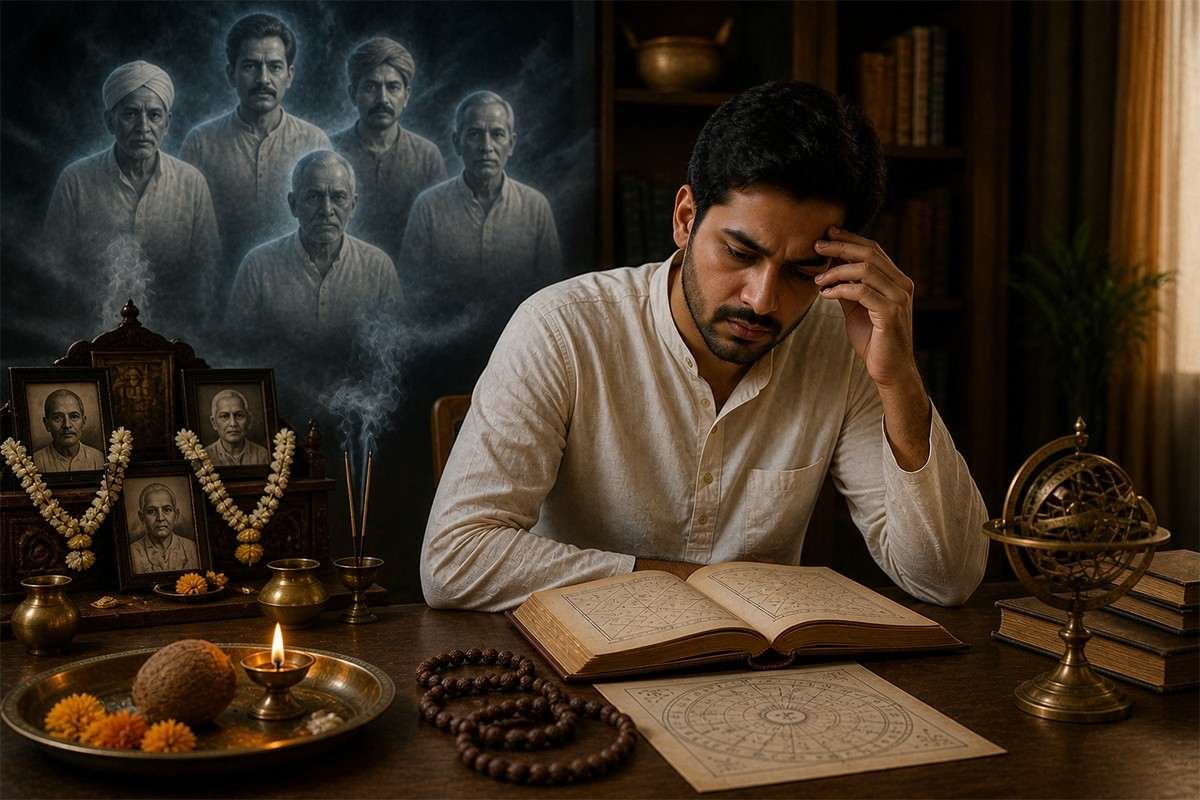
In Vedic philosophy, this configuration is generally attributed to karmic causes — actions or unresolved patterns from past experiences (including, in traditional belief, past lives) that manifest as this particular nodal arrangement at the moment of birth. It is described as a karmic condition to be understood and worked with, not as a punishment to be feared.
Does Kaal Sarp Dosha Guarantee Misfortune?
No — and this is the single most important point to understand. Even within classical tradition, Kaal Sarp Dosha is never treated as an isolated verdict on someone’s life. Its real significance depends on:
- The exact house placement and type of Kaal Sarp Dosha involved.
- Whether the configuration is “complete” (no planet at all outside the Rahu-Ketu axis) or “partial,” which many charts show once close degrees are examined.
- The strength, sign, and aspects of Rahu and Ketu themselves.
- The overall strength of the rest of the chart, including the Ascendant, Moon, and the running Dasha period.
Many people carry this configuration in their chart and lead successful, stable, happy lives — plenty of well-known and accomplished individuals are said to have this placement. Severity genuinely varies from person to person, and a single factor viewed in isolation should never be treated as a life sentence.
Traditional Remedies for Kaal Sarp Dosha
Vedic tradition offers a well-established set of remedial practices for those whose charts show this dosha in a meaningfully active form. As with all dosha-related remedies, these are complementary spiritual practices rooted in tradition — not scientifically verified cures — and should sit alongside, never replace, professional medical, legal, or financial advice where relevant to your situation.
- Kaal Sarp Dosha Puja: Traditionally performed at pilgrimage sites like Trimbakeshwar in Maharashtra, though a properly guided puja can also be arranged through a qualified priest elsewhere.
- Rahu-Ketu Shanti Hawan: A structured fire ceremony specifically dedicated to pacifying both nodes. Learn more about how such ceremonies are conducted through our hawan and pooja services.
- Mahamrityunjaya Mantra: Regular chanting of this powerful mantra dedicated to Lord Shiva is widely recommended for those with this dosha.
- Nag Panchami worship: Observing rituals on Nag Panchami, a festival specifically associated with serpent worship, is considered particularly relevant for this dosha.
- Silver serpent offerings: Offering a pair of silver snake idols in a flowing river or at a Shiva temple is a commonly followed practice.
- General spiritual practice: Consistent meditation, fasting, and charitable giving are broadly recommended to support emotional steadiness during periods when this dosha is considered active.
For a wider range of remedial and spiritual guidance beyond dosha-specific rituals, our spiritual solutions service offers a more holistic approach tailored to your particular chart and life circumstances.
Getting an Honest Reading of Your Chart
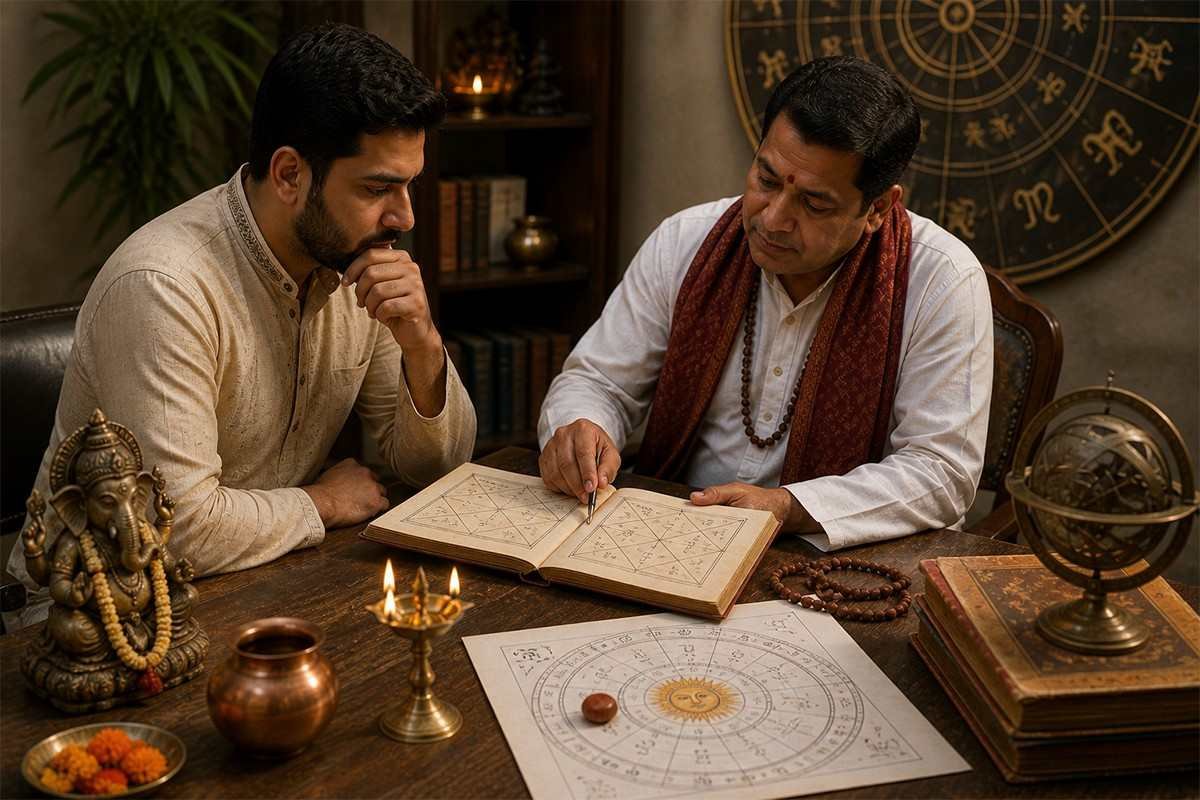
Because so much fear and misinformation circulates around Kaal Sarp Dosha online, we strongly encourage a proper, personalised chart reading before assuming this dosha is the cause of any struggles you’re experiencing — and before spending money on unnecessary remedies elsewhere. Astrologer Raj Bengali reviews the complete birth chart, confirms whether the dosha is genuinely present and in what form, and gives realistic, chart-specific guidance rather than generic fear-based warnings.
If you’d like a clear, honest analysis of whether Kaal Sarp Dosha appears in your chart — and what, if anything, is genuinely worth doing about it — call or WhatsApp Bengali Jyotish Center at +91-9779264257 to book a personal consultation with Astrologer Raj Bengali.
Frequently Asked Questions
Does everyone with Kaal Sarp Dosha face major problems in life?
No. This is a common misconception. Many people with this configuration in their chart lead entirely stable, successful lives. Its real impact depends on the specific type, whether it’s complete or partial, and the overall strength of the rest of the chart — not on the presence of the dosha alone.
How can I check if I have Kaal Sarp Dosha?
You need an accurate birth chart based on your exact date, time, and place of birth, reviewed by a qualified astrologer who can confirm whether all planets genuinely fall within the Rahu-Ketu axis, and identify which of the twelve types applies to you.
Is Kaal Sarp Dosha considered a curse from a past life?
Traditional Vedic philosophy frames it as a karmic configuration rather than a “curse” — a pattern to be understood and worked with through awareness and remedial practice, not a punishment. This framing is meant to be constructive rather than fear-inducing.
Can Kaal Sarp Dosha be completely removed through puja?
No remedy can be guaranteed to fully remove a chart configuration, since the placement itself doesn’t change. Traditional pujas and rituals are believed to ease its more challenging expressions and bring emotional and spiritual support, working best alongside continued practical effort in daily life.
At what age does Kaal Sarp Dosha’s influence reduce?
Classical tradition doesn’t give one fixed age for all types, since the effect is tied closely to the running planetary Dasha period, not age alone. An astrologer reviewing your specific Dasha sequence can give a more precise sense of which life phases are considered more sensitive for you.