
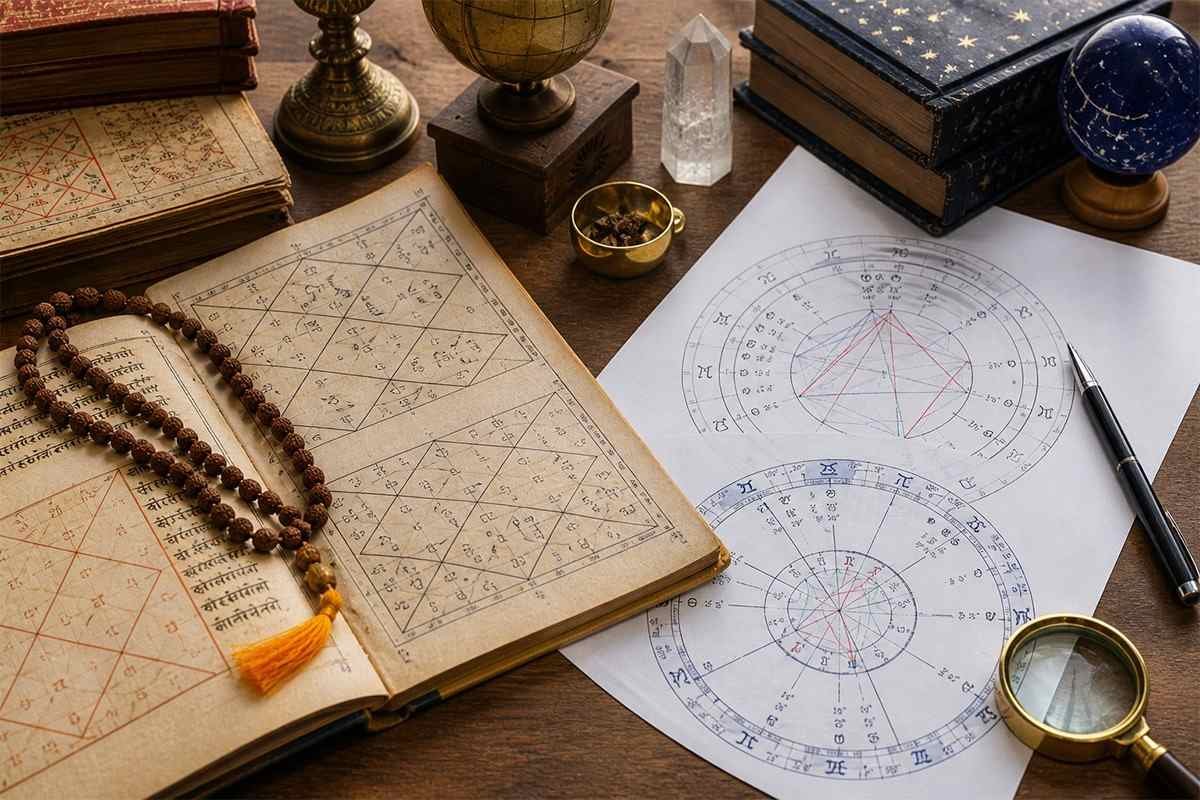
If you have ever compared your Western sun sign with the reading a Vedic astrologer gave you and found the two describing almost different people, you are not imagining things. Vedic astrology (Jyotish) and Western astrology share a common ancestry going back thousands of years, yet over centuries they developed into two distinct systems with different mathematics, different philosophies, and different goals. Understanding these differences can help you make sense of conflicting predictions and choose the approach that feels right for your questions about marriage, career, health, or family life.
At Bengali Jyotish Center, led by Astrologer Raj Bengali in Amritsar, Punjab, we practise the traditional Vedic system that has guided Indian families for generations. This article explains, in plain language, how Vedic astrology differs from Western astrology, so you can approach your own chart with clarity rather than confusion.
The Core Foundations: Two Ancient Systems, Two Worldviews
Western astrology, as it is practised today, traces its roots to ancient Mesopotamia and Greece, and was later refined through Roman, Arab, and European traditions. It is largely psychological and personality-focused in its modern form, often used to explore self-understanding, compatibility, and personal growth.
Vedic astrology, on the other hand, is rooted in the Vedas — the ancient scriptures of India — and is considered a Vedanga, or “limb of the Vedas,” specifically the branch dealing with timing (Jyotisha means “science of light”). It was traditionally used not only for personality insight but for practical, karma-based decision-making: choosing an auspicious wedding date, matching horoscopes before marriage, understanding the timing of life events, and identifying remedies for difficult planetary periods. You can read more about the historical roots of this system on Wikipedia’s overview of Hindu astrology.
This difference in origin shapes everything else: Western astrology tends to answer “what kind of person am I?” while Vedic astrology tends to answer “what is likely to happen, and when, and what can I do about it?”
The Zodiac Question: Sidereal vs Tropical
This is the single biggest technical difference between the two systems, and it explains why your sun sign can differ between a Western and a Vedic reading.
Western Astrology Uses the Tropical Zodiac
The tropical zodiac is fixed to the seasons. It begins at the point of the spring equinox every year, regardless of where the constellations actually sit in the sky at that moment. This zodiac essentially tracks the Earth’s relationship to the Sun through the seasons.
Vedic Astrology Uses the Sidereal Zodiac
The sidereal zodiac is fixed to the actual, observable positions of the constellations in the sky. Because of a slow wobble in the Earth’s axis known as the precession of the equinoxes, the tropical and sidereal zodiacs have drifted apart by roughly 24 degrees over the centuries. This is why a person born with the Sun tropically in Scorpio may, in the sidereal Vedic system, actually have their Sun placed in Libra. Vedic astrologers apply a correction called “ayanamsa” to account for this drift and keep the chart aligned with the visible sky.
Neither approach is “wrong” — they are simply built on different reference points and different philosophical priorities. But it does mean the two systems will often place your key planets in different signs, which is why the personality traits described can feel quite different.
Planets, Nodes, and the Importance of Rahu-Ketu
Both systems use the classical planets — Sun, Moon, Mars, Mercury, Jupiter, Venus, and Saturn. Modern Western astrology has also incorporated Uranus, Neptune, and Pluto since their discovery in the 18th, 19th, and 20th centuries.
Vedic astrology does not typically use these three outer planets in traditional prediction. Instead, it places enormous importance on two mathematical points called Rahu and Ketu — the north and south lunar nodes, the points where the Moon’s orbit crosses the Sun’s apparent path. In Vedic thinking, Rahu represents worldly desire, obsession, and unconventional ambition, while Ketu represents detachment, spirituality, and karmic release. These nodes are considered so influential that they can shape an entire life chapter, and much of traditional dosha analysis — including conditions like Kaal Sarp Dosha — revolves around their placement.
Divisional Charts (Vargas): A Vedic Specialty
One of the most distinctive features of Vedic astrology is the use of divisional charts, or vargas. While Western astrology generally relies on a single birth chart (the natal chart), Vedic astrology divides the zodiac into multiple sub-charts, each meant to zoom into a specific life area with greater precision.
- D-1 (Rashi chart): The main birth chart, similar in function to a Western natal chart.
- D-9 (Navamsa chart): Considered essential for marriage, spouse compatibility, and the deeper strength of planets — this is why serious horoscope matching in the Vedic tradition always studies the Navamsa alongside the main chart.
- D-10 (Dashamsa chart): Used to study career, profession, and public standing.
- D-7 (Saptamsa chart): Related to children and progeny.
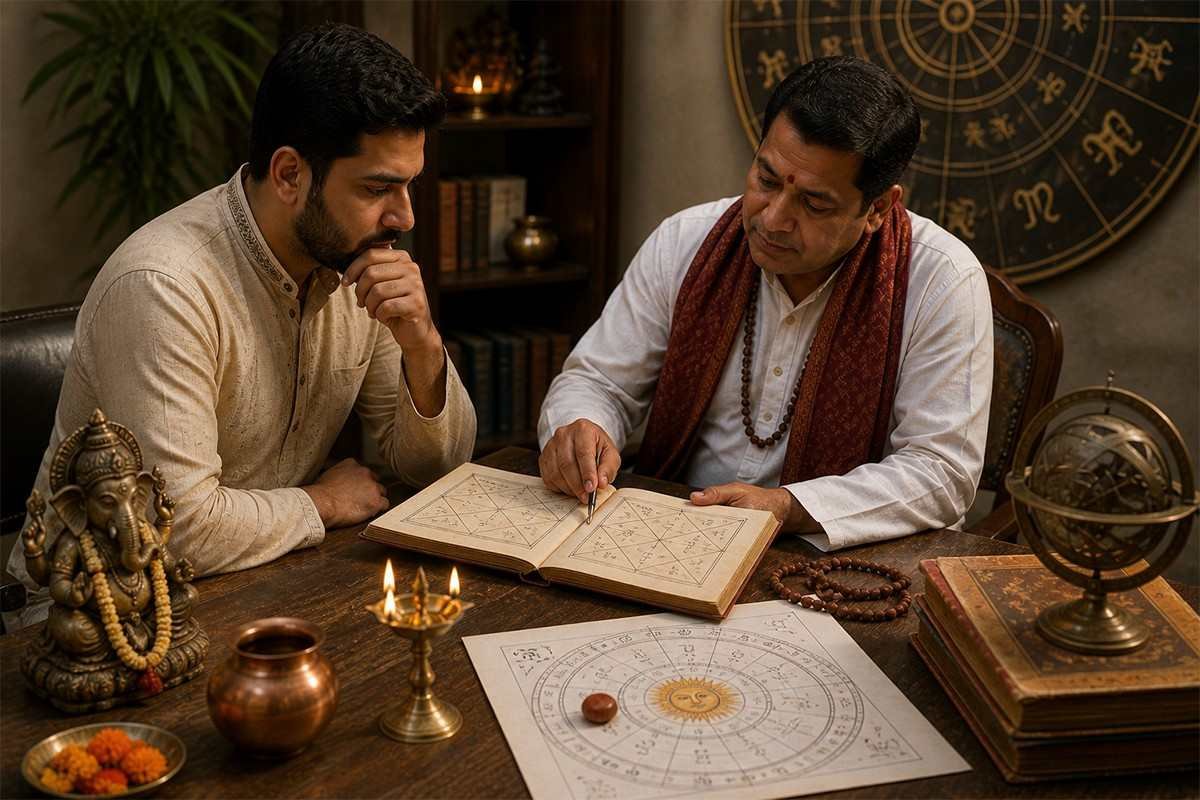
This layered, multi-chart approach is one reason a thorough Vedic reading can take considerably longer than a quick Western sun-sign summary — a competent astrologer is cross-checking several charts before offering an opinion, not reading from one diagram alone.
Dashas: The Vedic Timing System
Perhaps the most practically useful difference is timing. Western astrology primarily uses “transits” — the ongoing movement of planets against your natal chart — along with progressions, to estimate when events might occur.
Vedic astrology uses a unique and highly detailed system called Dasha, most commonly the Vimshottari Dasha, which divides a person’s life into planetary periods and sub-periods lasting anywhere from months to years, based on the Moon’s position at birth. Each Dasha period is said to bring the themes of its ruling planet to the forefront — a Saturn Dasha, for instance, often correlates with themes of discipline, delay, hard work, and long-term restructuring, while a Venus Dasha may bring themes of relationships, comfort, and creativity. This system is a major reason Vedic astrology is often described as more prediction-oriented than its Western counterpart.
Predictive Approach: Karma and Remedies vs Personality and Psychology
Modern Western astrology, especially as practised in the West today, leans heavily toward self-reflection, archetypes, and psychological insight. It rarely claims to predict fixed outcomes and instead frames the chart as a mirror for personal growth.
Vedic astrology retains a strong connection to the concept of karma — the idea that present circumstances are shaped by past actions across this life and, in Hindu philosophy, potentially past lives. Because of this framework, Vedic astrology traditionally pairs chart analysis with remedial measures: gemstone recommendations, mantras, fasting, charitable acts, and rituals like hawan (fire ceremonies) meant to strengthen weak planets or soften the impact of difficult periods. It is important to understand that these remedies are described in tradition as supportive and complementary practices — they are not guarantees, and they work best alongside sensible real-world effort, not as a substitute for it.
It’s worth being honest here: neither Vedic nor Western astrology is a scientifically validated predictive tool in the way medicine or physics is. Both are traditional belief systems that many people find meaningful, comforting, and useful for reflection and decision-making. A responsible astrologer — Vedic or Western — will always describe chart readings as indicating tendencies and probabilities, not certainties.
Which System Should You Trust?
This isn’t really a competition — the two systems answer different kinds of questions. If you want broad personality insight and a psychological lens on your inner world, Western astrology may resonate with you. If you are facing a specific life decision — a proposed marriage, a career crossroad, a run of bad luck, or unexplained family tension — the Vedic system’s emphasis on timing, divisional charts, and remedial guidance is often what Indian families have traditionally turned to for practical direction.
At Bengali Jyotish Center, we specialise exclusively in the Vedic approach, drawing on classical texts and decades of consultation experience across areas like marriage compatibility, career guidance, and family harmony. You can learn more about our background and approach on our about page, or explore the range of consultations we offer on our services page.
If your own chart is leaving you with more questions than answers — or you simply want a second, more traditional opinion — we invite you to reach out to Astrologer Raj Bengali for a personal, one-on-one chart analysis. Call or WhatsApp us at +91-9779264257 to book a consultation and get clarity grounded in classical Vedic principles rather than generic sun-sign summaries.
Frequently Asked Questions
Is Vedic astrology more accurate than Western astrology?
Neither system can be called scientifically “accurate” in a measurable sense — both are traditional belief systems. Many people in India find Vedic astrology more relevant for major life decisions because of its detailed timing tools and remedial framework, but accuracy ultimately depends on the astrologer’s skill and how the guidance is used.
Why is my zodiac sign different in Vedic astrology compared to Western astrology?
This happens because Western astrology uses the tropical zodiac (based on seasons) while Vedic astrology uses the sidereal zodiac (based on actual constellation positions). Over centuries these two reference points have drifted apart by roughly 24 degrees, shifting most signs by about one zodiac sign.
Can I combine insights from both Vedic and Western astrology?
Many people do use both for different purposes — Western astrology for general self-reflection and Vedic astrology for detailed timing and remedies. There is no conflict in exploring both, as long as you understand they are built on different calculation methods.
What makes Vedic astrology particularly useful for marriage matching?
Vedic astrology’s tradition of horoscope matching (Kundali Milan) uses detailed compatibility scoring across multiple factors, along with the Navamsa (D-9) chart, to assess long-term compatibility between partners — a level of structured analysis not typically found in Western astrology.
Do I need to choose one system permanently, or can my needs change?
Your needs can absolutely change. Someone might enjoy Western astrology for casual daily insight while consulting a Vedic astrologer specifically before a wedding, a major career move, or during a difficult life phase. Choose the approach that fits the question you’re actually trying to answer.