

Parents often look everywhere for an edge when a child is struggling to focus on studies — tutors, schedules, fewer distractions — but the layout of the study room itself is rarely considered, even though Vastu Shastra has fairly specific guidance on exactly this. This guide covers the traditional Vastu principles for a study room or study corner, and how they are believed to support focus and better academic outcomes.
Choosing the Right Direction for the Study Room
In Vastu Shastra, the North-East and East directions are generally considered the most favourable for a study area. East is associated with the rising sun and fresh, positive energy that is believed to support clarity and alertness, while North-East (Ishan corner) is traditionally associated with knowledge, wisdom, and spiritual energy, making it a particularly favoured placement for a dedicated study room where space allows.
Which Direction Should the Student Face While Studying?
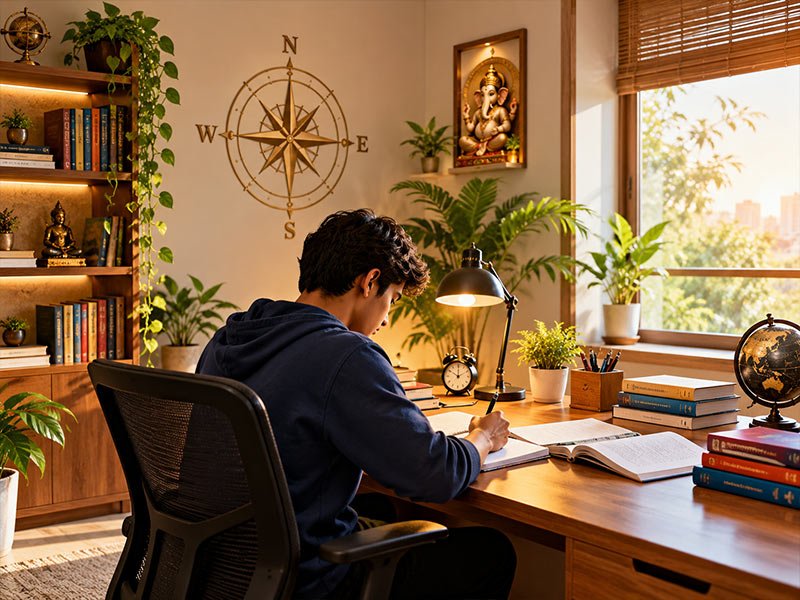
Beyond the room’s location, the direction a student faces while actually studying is considered just as important. Facing East is traditionally recommended to support concentration and absorption of new material, while facing North is also considered favourable, associated with career growth and professional success alongside academic focus. Facing South while studying is generally advised against in traditional Vastu guidance, as it is associated with reduced focus and increased restlessness.
Desk and Furniture Placement
A few specific placement principles come up consistently in Vastu guidance for study spaces:
- Avoid sitting directly under a beam. A study desk positioned beneath an exposed ceiling beam is traditionally considered to create subtle pressure and restlessness, making concentration harder.
- Keep the back supported by a solid wall. Studying with your back to an open door or window is generally discouraged, as it is believed to create a subconscious sense of insecurity that interferes with focus.
- Avoid a cluttered desk and an overflowing bookshelf. Visual clutter is considered to disrupt the flow of positive energy just as much as it is, more practically, simply distracting.
- Keep the study area separate from the bed, where possible. A desk placed too close to where a student sleeps is traditionally thought to blur the energetic distinction between rest and focused work.
Color and Lighting Considerations
Light, calming colors such as soft yellow, light green, or white are generally recommended for study room walls, associated with mental clarity and calm concentration, while dark or overly bright, stimulating colors are usually advised against. Good natural lighting is also emphasised — a study area that relies heavily on dim artificial light, even if positioned correctly by direction, is considered less supportive of sustained focus.
What If You Do Not Have a Dedicated Study Room?
Many homes, especially smaller ones, do not have the luxury of an entire room set aside for studying. In these cases, the same principles can usually be applied to a study corner within a bedroom or living area — prioritising the facing direction of the desk, avoiding beams and clutter, and choosing the most favourable available corner of the room, even if the room as a whole was not built with Vastu in mind. These are the same kind of practical, room-by-room adjustments we cover more broadly in our guide to common Vastu mistakes that invite negative energy.
Vastu Is a Support, Not a Substitute
It is worth being clear that Vastu adjustments to a study space are traditionally believed to support focus and reduce subtle friction — they are not presented as a substitute for actual study habits, adequate sleep, or addressing any genuine learning difficulty a child might be facing. If academic struggles persist despite a well-arranged study space, it is worth looking at the whole picture rather than relying on room layout alone, including our broader guidance on creating a peaceful and prosperous home overall.
If you would like a personalised Vastu assessment of your child’s study space, or a broader home energy consultation, Astrologer Raj Bengali at Bengali Jyotish Center in Amritsar offers detailed Vastu guidance. Call or WhatsApp +91-9779264257 to book a consultation. For more background on this practice, see Vastu Shastra.
Frequently Asked Questions
Which direction is best for a study room according to Vastu?
North-East and East are generally considered the most favourable directions for a study room, associated with knowledge, fresh energy, and mental clarity.
Which direction should my child face while studying?
Facing East or North is traditionally recommended to support focus and career growth. Facing South is generally advised against, as it is associated with restlessness and reduced concentration.
Is it bad to study under a ceiling beam?
Yes, according to Vastu principles, sitting directly under an exposed beam is believed to create subtle pressure and restlessness that can make concentration harder.
What colors are recommended for a study room?
Light, calming colors such as soft yellow, light green, or white are generally recommended, as they are associated with mental clarity, while dark or overly stimulating colors are usually advised against.
What if I do not have space for a separate study room?
The same principles can be applied to a study corner within an existing room — prioritising desk direction, avoiding beams and clutter, and choosing the most favourable available spot, even without a dedicated room.